🏛️ Newgrange (Ireland)
🔎 Quick Facts and Why It Matters
Newgrange is a prehistoric monument in Ireland, known for its ancient origins, stunning architecture, and astronomical significance. Built during the Neolithic era, it serves as both a burial ground and a testament to early human ingenuity.
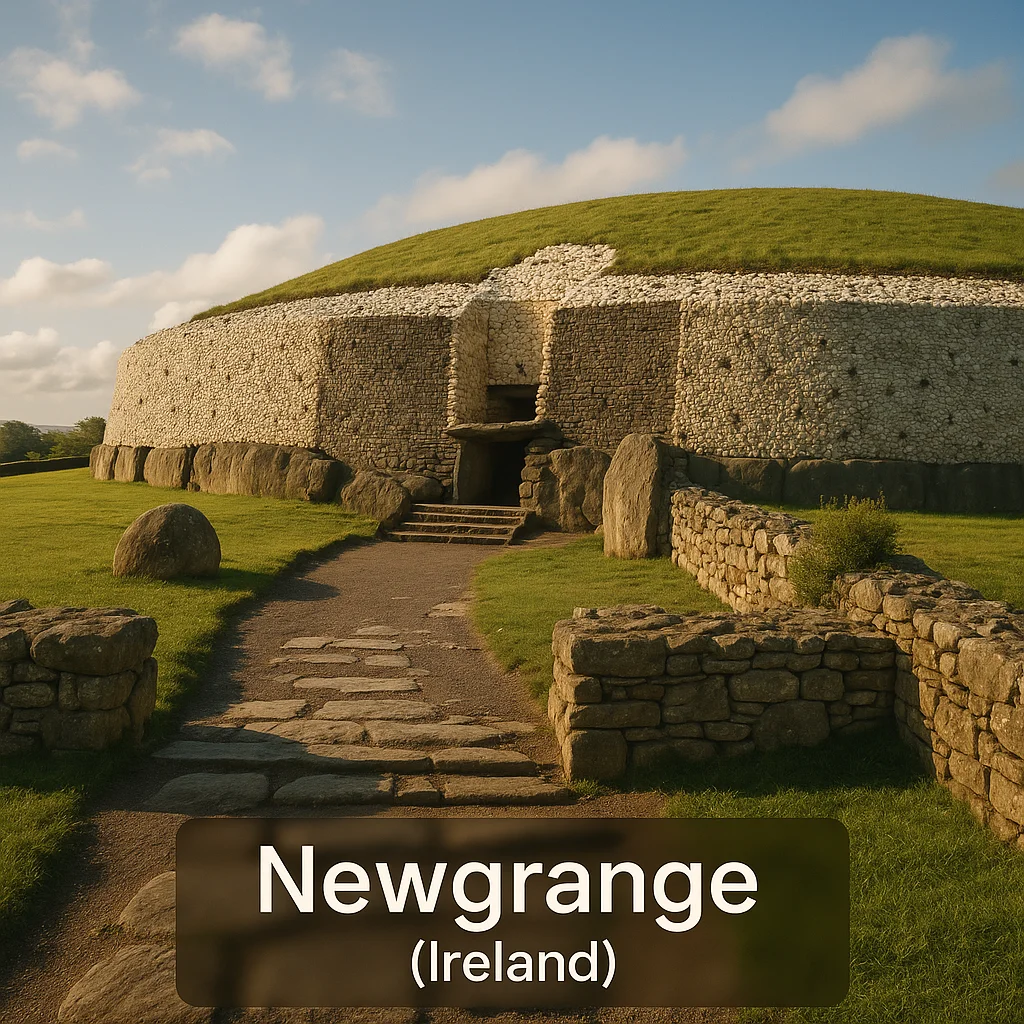
This iconic site is primarily renowned for its age and the architectural sophistication accomplished with limited technology. A visit to Newgrange offers a glimpse into prehistoric life and the importance of celestial events in ancient cultures.
Visitors can walk around the site, observe its meticulous construction, and learn from expert-guided tours. An exploration of Newgrange will provide insights into its historical significance and the mysteries that still surround it.
- Location: Ireland
- Era: Neolithic (around 3200 BC)
- Typical Visit Length: 2–3 hours
- Difficulty: Easy to moderate walk
- Best Season: Summer and winter solstice
- Highlight: Winter solstice sunrise illumination
🗺️ Where It Is and How to Orient Yourself
Newgrange is located in County Meath, Ireland, near the village of Donore. Situated in the Boyne Valley, it's easily reachable from Dublin, which is about an hour's drive away. The nearest major airport and rail hub are in Dublin, making it a convenient starting point for travelers.
It is realistic to visit Newgrange as a day trip from Dublin, although staying overnight in the Boyne Valley area allows for a more relaxed exploration and a chance to visit other nearby historical sites.
The monument itself is part of a larger complex including Knowth and Dowth, located on a rolling landscape beside the River Boyne. Visualize the site as a hill in the countryside, surrounded by green fields and connected by gentle paths.
🕰️ History in a Nutshell
Newgrange was constructed by ancient communities around 3200 BC, making it older than Stonehenge and the Great Pyramids of Giza. Primarily a passage tomb, it served as a burial site and possibly a place for rituals connected to the solar calendar.
At its peak, Newgrange was utilized as a significant ceremonial center. Its orientation towards the winter solstice sunrise indicates its use in religious or calendrical events. Over the centuries, it was abandoned, leading to its eventual rediscovery and preservation.
The monument's survival can be attributed to its robust construction and the protective soil and grass covering. Today, it stands as a well-preserved relic, celebrating ancient heritage and architectural prowess.
⭐ Top Highlights You Should Not Miss
- The Passage and Chamber
- The Entrance Stone
- The Solstice Illumination
- The Viewing Platform
The Passage and Chamber lie at the heart of Newgrange. This narrow, stone-lined corridor stretches inward, leading to a cruciform chamber where bones and offerings were found. Look for the corbelled roof, a marvel of prehistoric engineering.
The Entrance Stone, adorned with spiral and diamond motifs, is a striking feature. Its carvings are symbols thought to represent cosmological beliefs and the journey of the soul. Stand back to take in the full layout, highlighting the harmony of design with nature.
The Solstice Illumination is perhaps Newgrange's most famous feature. Each winter solstice, the rising sun perfectly aligns with the entrance, illuminating the inner chamber—a magical experience speaking to the astronomical knowledge of its builders.
From the Viewing Platform, one can appreciate a panoramic view of the Boyne Valley, providing an excellent context to grasp the site's grandeur and significance in the landscape.
🧱 Architecture, Materials, and Design (Made Simple)
Newgrange is constructed primarily of large stones and earth, with stones used for the passage, chambers, and kerb. The exterior is covered with white quartz, providing a luminous appearance that is both formidable and beautiful.
The architectural style, sometimes called Megalithic, features massive stones that required complex logistics to move and position. Unique details include the entrance stone's carvings and the corbelled interior which showcases advanced prehistoric engineering techniques.
Restoration efforts in the 1960s carefully aimed to replicate the original structure using gathered evidence, making distinctions between reconstructed elements and those left unchanged over time.
🎟️ Visiting Guide (Time, Tickets, and What to Expect)
A typical visit to Newgrange can range from a quick 1-hour walk to a deeper 3-hour exploration. A guided tour offers detailed insights into its history and architecture.
Visits are organized through the Brú na Bóinne Visitor Centre and usually require tickets, as access to the interior is regulated to preserve the site. Guided tours are often mandatory and can vary, with schedules susceptible to change.
Prepare for your visit by arriving early to secure tickets, carrying water, and wearing comfortable walking shoes. The climate may vary, so a hat and raincoat can also prove useful depending on the season.
🚆 How to Get There and Move Around
Newgrange can be accessed by car from Dublin, with significant signage leading to the site from the motorway. Public transport may involve a combination of train and bus, with services generally focused towards the Brú na Bóinne Visitor Centre.
Beginners may find self-driving the easiest, offering flexibility and convenience. The site's visitor center serves as the main entry point, simplifying navigation and easing logistical concerns for first-timers.
The terrain around Newgrange is mostly flat, with some paths paved for easy walking. Those with mobility challenges should note that access to the interior chamber involves narrow passages and steps.
🌤️ Best Season, Weather, and Time of Day
Summer and winter solstice are the most rewarding times to visit Newgrange due to their astronomical significance. Summer offers longer daylight, warmth, and lush scenery, while the winter solstice reveals the iconic sunlight passage.
An early morning or late afternoon visit maximizes sunlight for photos and enhances the overall experience with fewer crowds. If the weather turns rainy, nearby indoor sites like visitor centers provide alternative learning opportunities.
⚠️ Safety, Rules, and Respectful Etiquette
Wear sturdy, closed footwear to manage uneven ground. Dress appropriately for Ireland's changing weather, keeping in mind that warm or waterproof layers may be necessary depending on the season.
Observe all posted rules, as Newgrange is both a cultural and historical site. Flash photography inside the passage is typically prohibited, and drone use may face restrictions. Visitors are urged to remain on designated pathways.
Conservation is critical, so avoid climbing on structures or touching carvings. The site can become busy, so be aware of surroundings and keep personal belongings secure, exercising standard precautions against pickpockets.
🗺️ Nearby Places and a Simple One-Day Itinerary
The Boyne Valley offers sites like the Hill of Tara, Knowth, and Dowth as additional historical enrichments. The town of Drogheda nearby provides various amenities and local cultural experiences.
- Morning: Start at Newgrange early for guided tours
- Midday: Break for lunch at the visitor center's café
- Afternoon: Explore nearby Knowth or the Hill of Tara
- Evening: Evening stroll in Drogheda, dinner with local cuisine
🧩 Stories, Myths, and Common Questions
Is Newgrange an ancient tomb? Yes, but it also likely had ceremonial purposes tied to solar events.
Was it lost to history? While not entirely forgotten, its complete purpose and methods of construction are primarily understood through rediscovery in modern times.
Can children enjoy the visit? Yes, but narrow passages require supervision, and interactive exhibits at the visitor center can spark interest.
Is a guided tour worth it? Absolutely, as guides provide valuable context that enriches the experience immensely.
📌 Summary and Who This Site Is Best For
- An ancient Neolithic monument
- Located in County Meath, Ireland
- Reflects early human engineering skills and cultural practices
- Key highlights include the chamber, entrance stone, and solstice event
- Built with stone, featuring unique carvings and astronomical alignment
- Best visited for 2–3 hours with guided insights
- Ideal seasons are summer and winter solstice
- Wear sturdy shoes and respect conservation guidelines
- Nearby sites add value to the itinerary
- Memorable for its solstice illumination and ancient heritage
Newgrange captivates a wide range of interests. Families, photographers, history enthusiasts, and those intrigued by ancient cultures are especially drawn to its mysteries and beauty. Its accessibility from Dublin and its profound historical insights make it a worthy journey.
What ensures Newgrange's allure is not just its age but the science and spirituality it embodies. A visit provides a window into the past where astronomical events defined the rhythm of life. Approach the experience with respect and curiosity to fully appreciate its significance.
Experience Newgrange responsibly; its legacy is both a shared treasure and a reminder of human ingenuity through the ages.