🏛️ Parthenon – Acropolis (Greece)
🔎 Quick Facts and Why It Matters
The Parthenon, situated atop the Acropolis of Athens in Greece, stands as a symbol of ancient Greek civilization and its remarkable achievements in architecture and democracy. It is one of the most famous cultural monuments in the world, drawing millions of visitors each year.
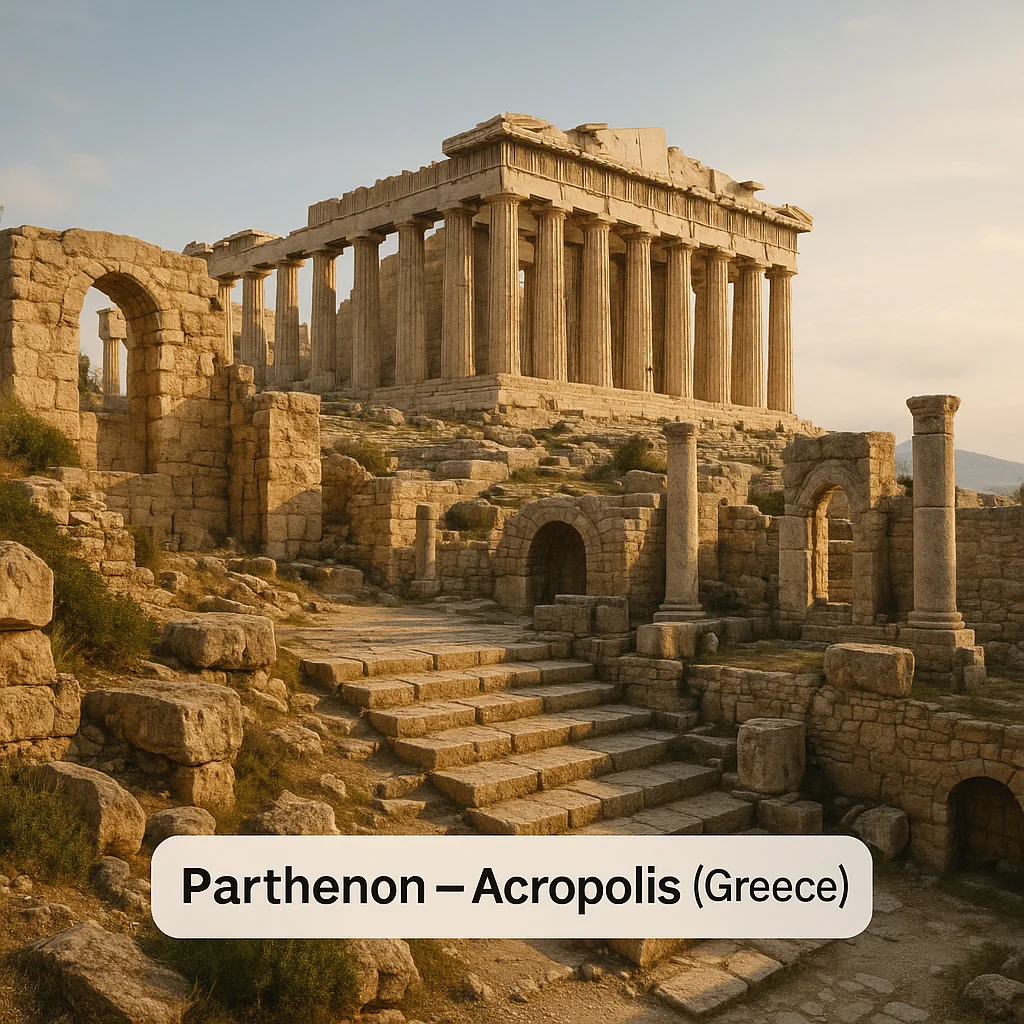
What makes the Parthenon special is its historical significance and the architectural brilliance it represents. This once magnificent temple was dedicated to Athena, the patron goddess of Athens, and symbolizes the political and cultural heights reached by the Athenian Empire during its golden age.
Visiting the Parthenon offers a walkable ruin experience with stunning viewpoints of Athens. The entire Acropolis site, with its backdrop of the modern city, provides a museum-style insight into ancient Greek life, culture, and architectural prowess.
This guide will help you understand the basic history of the Parthenon, orient yourself for a visit, appreciate its architectural elements, and plan a respectful and enriching trip to this exceptional World Heritage site.
- 📍 Country: Greece; Region: Attica
- ⏳ Era: Built in the 5th century BCE
- ⏱️ Typical visit length: 2-3 hours
- 🚶 Difficulty: Moderate (steep walkways)
- 🏖️ Best season to visit: Spring and autumn for mild weather
- 🎯 Highlight: The Parthenon and panoramic views of Athens
🗺️ Where It Is and How to Orient Yourself
The Acropolis is located in the heart of Athens, Greece, within the Attica region. Athens, being a major city, is the primary gateway for international travelers, with a well-connected airport and railway system to facilitate your journey.
The site of the Acropolis can be realistically visited as a day trip if you are staying in Athens. However, to truly appreciate its grandeur and allow time to explore nearby attractions, an overnight stay in the city is recommended.
As you envision the location, picture a hill rising above the Athenian skyline, providing a commanding view over the city and surrounding mountains. The Acropolis sits in an elevated position, with its structures visible from many locations throughout Athens.
🕰️ History in a Nutshell
The Parthenon was constructed in the 5th century BCE, during the height of the Athenian Empire. It was built under the leadership of Pericles by architects Iktinos and Kallikrates, with the famous sculptor Phidias overseeing the decorative sculptures.
Originally serving as a temple dedicated to Athena, the Parthenon was a centerpiece of religious and social life in ancient Athens. Over the centuries, it has been used as a treasury, a church, a mosque, and even suffered damage during conflict.
The Parthenon became a ruin due to a major explosion in the 17th century when it was used to store gunpowder, becoming severely damaged. Its current state speaks of its resilience and the ongoing efforts to preserve its remaining structure.
⭐ Top Highlights You Should Not Miss
- 🕌 The Parthenon
- 🧱 Erechtheion
- 🗿 The Propylaea
- 🏛️ Temple of Athena Nike
- 🌳 The Ancient Olive Tree
The Parthenon, the main highlight, is the largest building on the Acropolis and embodies classical Greek architectural principles. Look for the Doric columns and appreciate the extensive frieze, narrative freeze frames of ancient mythology, and history.
The Erechtheion is known for its Caryatids, the sculpted female figures serving as architectural supports. Don’t miss the best photo spot here, where you have a full view of the Caryatids against the blue sky of Athens.
The Propylaea serves as the grand entrance to the Acropolis, offering a heroic perspective of the site's architectural beginnings. Capture a wide view to include its full façade and the distant cityscape.
The Temple of Athena Nike is a smaller yet historically significant structure, representing victory in warfare. This spot offers panoramic views over Athens and the surrounding Saronic Gulf.
The Ancient Olive Tree represents the sacred connection of the Athenians to their patron goddess Athena. Positioned nearby the main structures, its context is enriched by the heritage it symbolizes.
🧱 Architecture, Materials, and Design (Made Simple)
The Parthenon is primarily built of Pentelic marble, known for its pristine white appearance and fine grain. Large stone blocks were meticulously cut, transported, and assembled without the use of mortar.
The classical Greek architecture of the Parthenon is defined by its strict adherence to proportionality, harmony, and detailed decorative elements. Its Doric columns, lack of base, and use of simple, sturdy lines characterize the style.
Unique details, such as the slightly curved columns and floors, create an optical illusion of straightness, highlighting the sophistication of Greek engineering. Carved metopes and friezes narrate stories of mythology, exemplifying ancient artisanship.
Some restoration efforts have taken place to stabilize the structure, using compatible materials to preserve the integrity of its original design while ensuring safety for future generations.
🎟️ Visiting Guide (Time, Tickets, and What to Expect)
Visitors typically spend between 2-3 hours exploring the Acropolis and the Parthenon, extending this time if visiting the nearby museum. A standard visit includes access to the entire archaeological site, and guided tours are available for a more in-depth experience.
The Acropolis generally operates from morning to late afternoon, with variations depending on the season. Entrance requires a ticket, with discounts often available for students and seniors.
For first-time visitors, it is advisable to arrive early to avoid the peak afternoon crowds and heat. It's beneficial to carry water and wear comfortable shoes due to the uneven and sometimes steep pathways.
🚆 How to Get There and Move Around
The Acropolis can be reached via public transportation from central Athens, with metro and bus routes connecting visitors to the nearest stations. Taxis and rideshare services offer convenient alternatives.
The main entrance is recommended for beginners, offering a straightforward route to the key structures of the site. Be mindful of the accessibility challenges posed by steep steps and uneven terrain, which may be difficult for those with mobility issues.
🌤️ Best Season, Weather, and Time of Day
The best seasons to visit the Acropolis are spring (April-May) and autumn (September-October) when the weather is mild and the site is less crowded. Summer visits can be quite hot, making early mornings or late afternoons preferable for cooler temperatures.
A rainy-day alternative includes exploring the Acropolis Museum, which houses significant artifacts and offers insights into the site's history in a climate-controlled environment.
⚠️ Safety, Rules, and Respectful Etiquette
Wear sturdy shoes to navigate the uneven stones and steep steps safely. Respect the site's cultural value by maintaining quiet in designated sacred areas and adhering to posted signs and guidelines.
Photography is generally allowed, but flash, drones, and climbing on structures are prohibited to protect the site. Always stay on designated pathways to preserve the fragile remains.
Be aware of practical risks, such as slippery surfaces when wet, and protect yourself from sun exposure with hats and sunscreen, especially during midday.
🗺️ Nearby Places and a Simple One-Day Itinerary
Extend your exploration with visits to the Acropolis Museum, Ancient Agora, the Theater of Dionysus, the National Archaeological Museum, and the charming Plaka neighborhood.
- 🌅 Morning: Start your day with a visit to the Acropolis and the Parthenon.
- 🗿 Midday: Explore the Acropolis Museum for a detailed look at artifacts.
- 🌳 Afternoon: Wander through the Ancient Agora and the Theater of Dionysus.
- 🍽️ Evening: Enjoy dinner in the historic Plaka, surrounded by picturesque streets.
🧩 Stories, Myths, and Common Questions
Myth: Is the Parthenon one of the Seven Wonders of the Ancient World? Answer: No, though renowned, the Parthenon is not listed among the traditional Seven Wonders.
Misunderstanding: Was the Parthenon a palace? Answer: No, it was a temple dedicated to the goddess Athena.
Visitor Question: How difficult is the walk to the Parthenon? Answer: It requires moderate physical effort with some steep pathways.
Family Consideration: Is the Acropolis kid-friendly? Answer: Yes, but supervision is needed, especially due to uneven and steep paths.
Guide Question: Is a guided tour recommended? Answer: Yes, for enriching context and detailed history often overlooked in self-guided visits.
📌 Summary and Who This Site Is Best For
- The Parthenon is an ancient Greek temple on the Acropolis of Athens.
- It is located in Athens, Greece, easily accessible from the city center.
- Key history: Built in the 5th century BCE, it served as a temple to Athena.
- Top highlights include the Parthenon, Erechtheion, and Propylaea.
- The architecture is distinctively ancient Greek, known for its Doric columns.
- Typical visits last 2-3 hours; guided tours offer deeper insights.
- Best season is spring or autumn for mild weather and less crowded conditions.
- Maintain respect for the site by following posted rules and using caution on uneven pathways.
- Nearby add-ons include the Acropolis Museum, Ancient Agora, and Plaka.
- A memorable fact is the Parthenon's slight optical curvature, showcasing advanced Greek engineering skills.
The Parthenon and the Acropolis of Athens are especially appealing for families, photographers, and history enthusiasts. The art, history, and culture nest gracefully in a sublime narrative of Greek achievements.
Its timeless beauty and educational value make it worth the effort, offering insights into ancient Greek civilization and timeless architectural fascination.
Approach your visit with respect and curiosity to fully appreciate the legacy of one of the world's most enduring cultural landmarks.