🏛️ Delphi – Temple of Apollo (Greece)
🔎 Quick Facts and Why It Matters
The Temple of Apollo at Delphi is one of ancient Greece's most revered sites, famous for being the home of the Oracle of Delphi and offering profound insights into the religious and cultural practices of ancient civilizations.
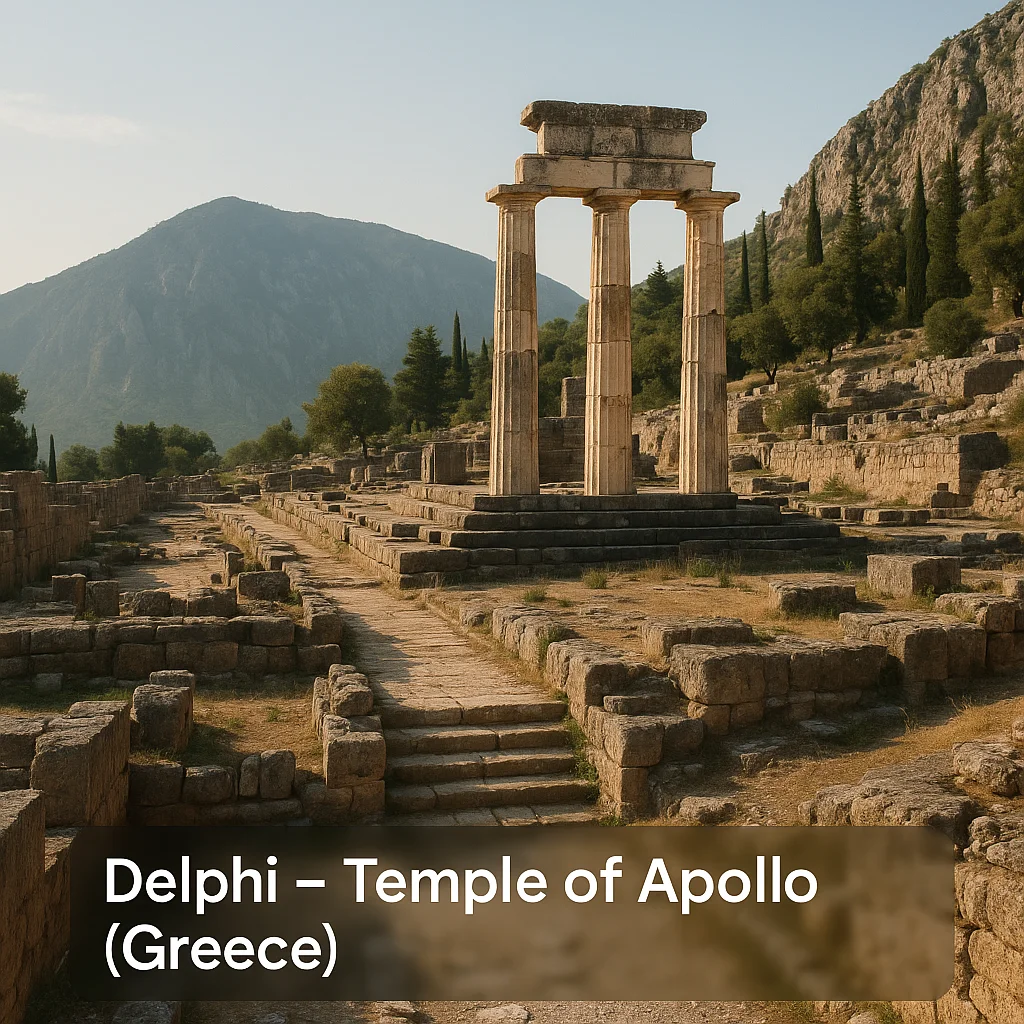
This site stands out for its historical significance and the mysteries that its ruins continue to unravel. Visitors often come to explore its walkable ruins and panoramic viewpoints that offer both a glimpse into the past and breathtaking natural scenery.
In this guide, you'll learn about the temple's fascinating history, architectural nuances, and the best ways to plan your visit. Get ready to immerse yourself in a place where the ancient world comes alive.
- Country/Region: Greece, Central Greece
- Era: Built in the 4th century BC
- Typical Visit Length: Half-day to full-day
- Visit Difficulty: Moderate (uneven terrain)
- Best Season: Spring and Autumn
- Highlight: The ancient ruins and breathtaking landscape views
🗺️ Where It Is and How to Orient Yourself
Delphi is located in Central Greece, on the slopes of Mount Parnassus. It's conveniently situated within the modern administrative region of Phocis.
The closest major city is Athens, a common entry point for international visitors. From Athens, Delphi can easily be reached by road, making it a feasible day trip option. However, many travelers prefer to extend their visit to fully appreciate the cultural and historical richness of the area.
Picture Delphi nestled against a picturesque mountain valley setting. The views alone offer a magnificent panorama encompassing the surrounding landscapes, creating a stunning backdrop for exploring the ruins.
🕰️ History in a Nutshell
The temple was built by the Greeks during the late 4th century BC and served as a major religious sanctuary dedicated to Apollo, the god of music, truth, and prophecy.
During its peak, Delphi was the site of the Pythian Games and hosted hundreds of visitors seeking the oracle's prophecies. However, over time, political changes and natural disasters like earthquakes led to its decline.
Today, the ruins survive mainly due to the durable craftsmanship of ancient builders and continuing preservation efforts. As a result, visitors can still experience a portion of its past glory.
⭐ Top Highlights You Should Not Miss
- The Temple of Apollo
- The Treasury of the Athenians
- The Ancient Theatre
- The Stadium
- The Castalian Spring
The Temple of Apollo is the central attraction. It is the symbolic heart of Delphi and offers the best location for a full-structure view from several points around the site. Look for the Doric columns that define its profile.
The Treasury of the Athenians features intriguing inscriptions and its restoration provides an excellent spot to ponder the wealth and influence of Athens. Capture its entire façade in the frame for a memorable photo.
The Ancient Theatre offers seating in a semi-circular design providing not just historical context but also a sweeping view of the valley below. Photographs from the upper tiers can capture a wide panorama.
At the northern end, the Stadium evokes the athletic spirit of the Pythian Games and remains a must-see for understanding the site's cultural significance.
The Castalian Spring is considered sacred and is where visitors once purified themselves. It remains a serene spot perfect for reflection.
🧱 Architecture, Materials, and Design (Made Simple)
The structures at Delphi primarily use local limestone and marble, shaped with great precision. The Temple of Apollo showcases a Doric style that emphasizes simplicity and strength through its substantial columns and understated decoration.
Look out for the characteristic fluted columns, metopes (the rectangular panels between the columns), and triglyphs (three vertically-grooved elements). Together, these form part of the timeless Doric order recognizable across Greek architecture.
Though parts of the site have been reconstructed to various degrees, care has been taken to preserve the ruins while providing enhanced context for visitors, ensuring an authentic experience.
🎟️ Visiting Guide (Time, Tickets, and What to Expect)
Plan to spend at least a half-day at Delphi for a comprehensive visit, though a full day allows a deeper exploration. Most areas of the ruins are open with an entrance fee, while the adjacent museum requires a separate ticket.
Regular visiting hours run from early morning until late afternoon, though these can shift seasonally. When planning, consider arriving early to beat the crowds and take advantage of cooler temperatures.
Practical first-time tips include wearing comfortable shoes for navigating uneven paths, bringing water, and using sun protection like hats and sunscreen.
🚆 How to Get There and Move Around
From Athens, options include a coach trip, car rental for a scenic drive, or arranging for a taxi. While public buses run directly to Delphi, they vary in frequency.
The site has a main entrance which is best for first-time visitors as it leads directly to the Temple and comprehensive signage ensures easy navigation.
Be aware of the site's varying altitude and prepare for steep and uneven paths. While these may be challenging, they are navigable with care.
🌤️ Best Season, Weather, and Time of Day
Spring and autumn provide the most comfortable conditions with moderate weather and fewer crowds. The colors of surrounding foliage can also enhance the experience.
If you plan to visit in summer, aim for an early morning or late afternoon visit when the light is softer, bringing both beauty and cooler temperatures to your exploration.
In case of a rainy day, the Delphi Archaeological Museum offers an excellent indoor alternative with a rich collection of artifacts from the site.
⚠️ Safety, Rules, and Respectful Etiquette
Wear sturdy, comfortable shoes to navigate the rocky paths, and be prepared for high temperatures or sudden weather changes.
Respect sacred and quiet areas, following posted signs, and avoid loud behavior. Photography is generally allowed, but drones and flash photography might be restricted, so check on-site rules.
Stay on marked paths to protect the site and avoid damage to the ruins. This is not just a safety measure but a respect for ongoing preservation work.
Be mindful of potential risks such as slippery stones or heat-related issues, and remain vigilant in crowded areas to avoid pickpockets.
🗺️ Nearby Places and a Simple One-Day Itinerary
- Morning: Explore the Temple of Apollo and the Treasury of the Athenians.
- Midday: Visit the Delphi Archaeological Museum for a curated collection of artifacts.
- Afternoon: Enjoy a short hike or relax at the Castalian Spring.
- Evening: Dine in the nearby village of Delphi with its scenic views and traditional Greek cuisine.
Nearby, consider visiting the Corycian Cave for a short hiking expedition or the picturesque village of Arachova for its charming streets and local crafts.
The combination of historical exploration and scenic leisure activities within a day's itinerary makes for a balanced and fulfilling visit.
🧩 Stories, Myths, and Common Questions
Was the Oracle's insight genuinely mystical? Many believe the Oracle's prophecies were influenced by geological phenomena, as natural gases are thought to have played a role in inducing trance states.
Is it true Delphi was once the center of the world? According to Greek mythology, Zeus sent two eagles across the world and they met at Delphi, marking it as the world's navel.
How challenging is the walk? While the terrain is uneven, the main paths are well-maintained. Decent physical condition is advisable but not mandatory.
Is the site kid-friendly? Yes, but children should be supervised around steep areas and fragile ruins.
Are guided tours worth it? They can greatly enhance understanding, especially for those new to Greek history and mythology.
📌 Summary and Who This Site Is Best For
- What it is: The Temple of Apollo at the ancient site of Delphi.
- Where it is: Central Greece on Mount Parnassus.
- Key history takeaway: A major religious center dedicated to Apollo.
- Top highlights: Temple ruins, Ancient Theatre, panoramic views.
- Architecture/materials: Doric style with limestone and marble.
- Visit length guidance: Half-day to a full day.
- Best season/time: Spring or autumn, early morning or late afternoon.
- Safety/etiquette: Respect sacred areas, wear sturdy shoes.
- Nearby add-ons: Delphi Museum, Corycian Cave, Arachova Village.
- One memorable fact: Site of the Pythian Games, second only to the Olympics in ancient Greece.
Delphi appeals widely to history enthusiasts, photographers, and families seeking a deep dive into ancient Greek culture. The stunning natural landscapes and rich lore offer something for everyone.
Overall, the temple and its surroundings provide a profound cultural excursion that balances historic immersion with the beauty of nature, making the trip truly worth the effort.
We encourage respectful and mindful visiting to preserve the precious history and landscapes for future generations to appreciate and learn from.