🏛️ Angkor (Cambodia)
🔎 Quick Facts and Why It Matters
Angkor, located in Cambodia, is one of the world's most famous archeological sites, renowned for its stunning temple complex and historical significance as the heart of the Khmer Empire.
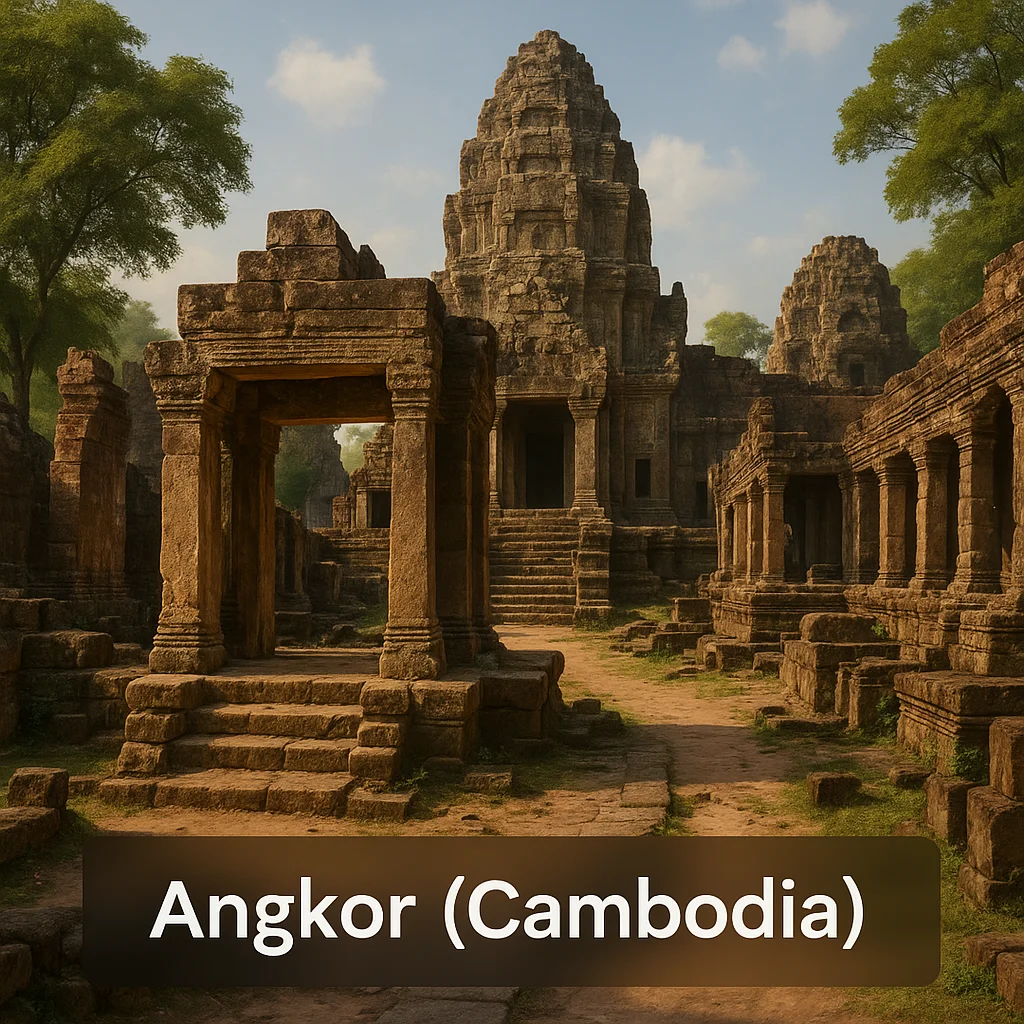
Spanning over 400 square kilometers, Angkor is a vast area filled with ruins, ancient temples, and a rich history that dates back to the 9th century. Its centerpiece, Angkor Wat, is the largest religious monument in the world and a UNESCO World Heritage Site.
Visitors can walk among the ruins, explore hidden corners, and experience breathtaking views that capture the grandeur of a civilization once at its zenith. This guide will help you understand the essential features of Angkor, navigate the site efficiently, and enhance your visit with a deeper appreciation of its history and architecture.
- Country: Cambodia
- Region: Northwestern Cambodia
- Era: Primarily 9th to 15th century
- Typical visit length: 1 to 3 days
- Accessibility: Moderate difficulty (uneven terrain)
- Best season: Cool, dry season (November to February)
- Highlight: Angkor Wat
🗺️ Where It Is and How to Orient Yourself
Angkor is situated in the northwestern part of Cambodia, near the city of Siem Reap. This serves as the primary gateway for tourists, equipped with an international airport and an assortment of accommodation options.
While it is possible to visit Angkor as a day trip from Siem Reap, the sheer size and number of significant sites mean that an overnight stay is highly recommended for a more comprehensive experience.
The ruin complex is surrounded by densely forested areas and interconnected by a network of roads. Envision it as part of a sprawling plateau punctuated by temple mountains and grand reservoirs, known as barays, which define the ancient landscape.
🕰️ History in a Nutshell
The Angkor complex was constructed by the Khmer Empire during its peak from the 9th to 15th centuries. The Khmer kings built this as a capital city and as a temple, demonstrating both political power and religious devotion.
Initially developed by King Jayavarman II, Angkor became the heart of the empire, reaching its zenith with Angkor Wat's construction in the early 12th century under King Suryavarman II.
The site fell into decline after the 15th century due to factors such as changing trade routes, military conflicts, and resource depletion, eventually being abandoned to the encroaching jungle, which both preserved and obscured its ruins.
⭐ Top Highlights You Should Not Miss
- Angkor Wat
- Bayon Temple
- Ta Prohm Temple
- Banteay Srei
- Preah Khan
Angkor Wat is the site's crown jewel, featuring an iconic ensemble of towering spires and intricate bas-relief galleries. The best photo spot is from the main approach causeway, offering a full structure visible against the reflection pools.
Bayon Temple, known for its mysterious smiling faces, is a maze of galleries and towers. Capture its stunning visuals from the terrace, allowing a wide view with surrounding context.
Ta Prohm Temple is famous for the trees enveloping its ruins. Its photogenic nature can be best appreciated from the main entrance, showing the intermingling of human and natural structures.
Banteay Srei, located further from the main complex, is renowned for exquisite sandstone carvings. The entire façade in frame can be appreciated in the soft morning light.
Preah Khan, a former monastery, offers a fascinating exploration experience, with features like ceremonial halls and entranceways, all best seen from its central courtyard.
🧱 Architecture, Materials, and Design (Made Simple)
The temples of Angkor are primarily constructed from sandstone blocks, carved with detailed bas-reliefs and sculptures. These durable materials have ensured the longevity of many structures, even after centuries of exposure to the elements.
The architectural style is distinctively Khmer, featuring temple mountains (symbolizing mythical Mt. Meru), enclosed corridors, and precisely aligned buildings. Detailed depictions of epic scenes from Hindu mythology adorn the walls, representative of the spiritual influences of the time.
Unique details include the enigmatic faces of Bayon, the roots entwined with Ta Prohm, and Banteay Srei's elaborate carvings. Some restoration work has been necessary; however, care is taken to preserve the authenticity of original remains.
🎟️ Visiting Guide (Time, Tickets, and What to Expect)
A typical visit ranges from a quick half-day tour to an in-depth, three-day exploration. It is advisable to start at sunrise to take full advantage of the cooler temperatures and avoid crowds.
Entry requires a day pass, which should be purchased in advance. Tickets grant access to all the major temples within the Angkor complex, though guided tours are an additional option for those seeking further insights.
The site is generally open from early morning until late afternoon, though the availability of facilities can vary, and seasonal changes to timings may occur. Visitors are encouraged to check local information sources before planning.
First-time visitors should prepare by carrying water, wearing comfortable shoes, planning intervals for rest in shaded areas, and bringing a hat and sunscreen to combat heat and sun exposure.
🚆 How to Get There and Move Around
The most common way to reach Angkor from Siem Reap is by tuk-tuk, a local form of motorized rickshaw. This option allows flexibility and a more immersive experience as you journey through the surrounding countryside.
For those preferring a different mode of exploration, bicycles and electric scooters are available for rent directly in Siem Reap, offering a sustainable alternative for the eco-conscious traveler.
Angkor has several entrances; however, the main entrance near Angkor Wat is the most straightforward for beginners, providing easy access to key highlights and a clearer route through the site's core.
Visitors should be mindful of accessibility options and limitations; some areas feature steep steps and uneven terrain, which may present challenges for some visitors.
🌤️ Best Season, Weather, and Time of Day
The best time to visit Angkor is during the dry season, from November to February, when temperatures are more comfortable, and the skies are clearer, perfect for photography.
Early mornings and late afternoons offer the best conditions for exploring and capturing the beauty of the temples bathed in soft, warm light.
In case of rain, visitors can explore Siem Reap's Angkor National Museum, which provides an excellent introduction to the history of the area and its artifacts, serving as an ideal rainy-day alternative.
⚠️ Safety, Rules, and Respectful Etiquette
Sturdy footwear is recommended due to the uneven ground and steps. Light, breathable clothing is advisable, with shoulders and knees covered to conform with cultural norms in sacred spaces.
Visitors should maintain respect in quiet areas and adhere to any posted signage, particularly in areas of religious significance. Photography is generally permitted, but be considerate of flash usage and any specific restrictions, such as drones.
Conservation efforts depend on visitor cooperation; it is crucial to stay on marked paths, avoid climbing on ruins, and refrain from touching fragile carvings to prevent degradation.
Finally, while crime is not prevalent, being aware of your belongings and any uneven surfaces will ensure a safe visit free from common pitfalls like slipping or losing valuables.
🗺️ Nearby Places and a Simple One-Day Itinerary
Besides the Angkor complex, other fascinating sites near Siem Reap include Phnom Kulen National Park, Tonle Sap Lake with its floating villages, and the Cambodia Landmine Museum.
- Morning: Start with a sunrise visit to Angkor Wat.
- Midday: Explore Bayon Temple and the surrounding Angkor Thom.
- Afternoon: Venture to Ta Prohm, followed by a trip to Banteay Srei.
- Evening: Conclude with a peaceful reflection at Preah Khan before returning to Siem Reap.
🧩 Stories, Myths, and Common Questions
Can Angkor Wat be seen from space? While it is enormous, Angkor Wat itself is not visible from space with the unaided eye. However, satellites can capture images of its grand scale.
Was it lost in the jungle? Angkor was never truly "lost." Local Khmer people were always aware of it, though it was largely unknown to the Western world until the 19th century.
Who constructed Angkor? Angkor was built by the Khmer Empire, a powerful Southeast Asian civilization. The exact purposes varied from temple worship to serving as a thriving urban center.
How challenging is it to explore? The main areas are reasonably approachable for most visitors, though some remote sites require more effort and stamina.
Is hiring a guide beneficial? A guide can enhance the experience by providing historical context and helping to navigate the dense area efficiently.
📌 Summary and Who This Site Is Best For
- Iconic world archaeological site
- Located near Siem Reap, Cambodia
- Capital of Khmer Empire (9th-15th century)
- Highlights include Angkor Wat, Bayon, Ta Prohm
- Built with intricate sandstone carvings
- Plan for 1 to 3 days to explore
- Best visited in cool, dry season
- Respectful behavior and dress are important
- Nearby sites: Phnom Kulen, Tonle Sap
- UNESCO World Heritage Site
- Perfect for history lovers and architectural enthusiasts
Overall, Angkor offers a captivating experience for anyone intrigued by ancient history and architectural grandeur. It invites families, photographers, and avid history lovers to delve into the past of one of Southeast Asia's greatest civilizations.
Its mystical allure and monumental achievements make the journey to Angkor worth every moment spent exploring its sprawling landscapes and intricate architectures.
As you embark on this journey, remember to venture respectfully, preserving the awe-inspiring remnants of Angkor for future generations to explore and admire.